Emerging Interaction Paradigm:
Mixed Reality in Higher Education
A comprehensive UX research study exploring how Mixed Reality technology can enhance learning experiences through Human-Computer Interaction principles, user-centered design, and ethical innovation in educational environments.
Redefining Learning Through Immersive Interaction
Technology has transformed the way people learn, communicate, and interact with digital environments. Among the emerging interaction paradigms, Mixed Reality (MR) stands out because it combines physical and virtual elements to create immersive experiences that feel more natural and interactive for users.
This portfolio presents the development process carried out during the activity, including the analysis of the selected paradigm, prototype design, usability testing, and the improvements proposed after receiving user feedback. The project was developed from the perspective of Human-Computer Interaction (HCI) and User Experience (UX), focusing on usability, accessibility, and user-centered design.
Learning Focus
Immersive educational experiences
HCI Principles
User-centered design methodology
Innovation
Emerging interaction technologies
Beyond Traditional Interfaces
Spatial Computing
MR enables spatial interaction with digital content, allowing students to manipulate 3D objects, explore virtual environments, and engage with information in three-dimensional space.
Collaborative Learning
Shared MR environments foster collaborative problem-solving, enabling multiple users to interact with the same virtual objects simultaneously.
Enhanced Engagement
Research demonstrates that immersive experiences increase student engagement by 40-60% compared to traditional screen-based learning.
Traditional vs. Mixed Reality
- 2D screen-bound interaction only
- Mouse and keyboard input limitation
- Passive content consumption
- Limited spatial awareness
- 3D spatial interaction
- Gesture, gaze, and voice input
- Active content manipulation
- Full environmental integration
Core Technologies & Infrastructure
Mixed Reality integrates digital information into the physical world using technologies such as sensors, spatial mapping, interactive displays, and head-mounted devices. From the perspective of HCI, MR changes the way users interact with systems because communication becomes more natural through gestures, movement, and voice interaction.
Instead of simply clicking on a screen, users become active participants within immersive environments. In educational contexts, MR can improve practical learning experiences by allowing students to interact with simulations that would be difficult or expensive to recreate in real life.
Spatial Tracking
6DoF tracking, SLAM algorithms, depth sensors
Gesture Recognition
Hand tracking, finger articulation, natural gestures
Holographic Display
Waveguide optics, light field rendering
Cloud Processing
Edge computing, 5G connectivity
Design for All Users
Usability is essential in immersive systems because users need interfaces that are easy to understand and navigate. A well-designed MR experience should provide clear instructions, intuitive interactions, and organized visual elements.
Although immersive technologies can increase motivation and engagement, they may also generate cognitive overload if users receive too much information at the same time. Designers must simplify interactions and guide users throughout the experience.
| Criterion | Description | Importance |
|---|---|---|
| Learnability | Intuitive onboarding for first-time MR users | High |
| Cognitive Load | Prevent overwhelming users with excessive information | High |
| Accessibility | Support different abilities and needs | Critical |
| Visual Clarity | Clear buttons, icons, and menu visibility | High |
Responsible Innovation
Mixed Reality systems may collect sensitive user information such as movement patterns, voice data, and interaction behaviors. Because of this, it is important to guarantee privacy, informed consent, and responsible data management in educational environments.
From a social perspective, MR can improve educational quality and innovation. However, unequal access to immersive technologies may increase the digital divide between students who have access to advanced resources and those who do not.
Privacy Issues
Continuous environmental data capture requires strict governance frameworks.
Data Collection
Interaction analytics and learning behavior tracking require transparent policies.
Digital Divide
Access concerns require shared resource models to prevent exclusion.
Responsible Implementation
Faculty training and gradual adoption strategies ensure success.
Seven-Phase Methodology
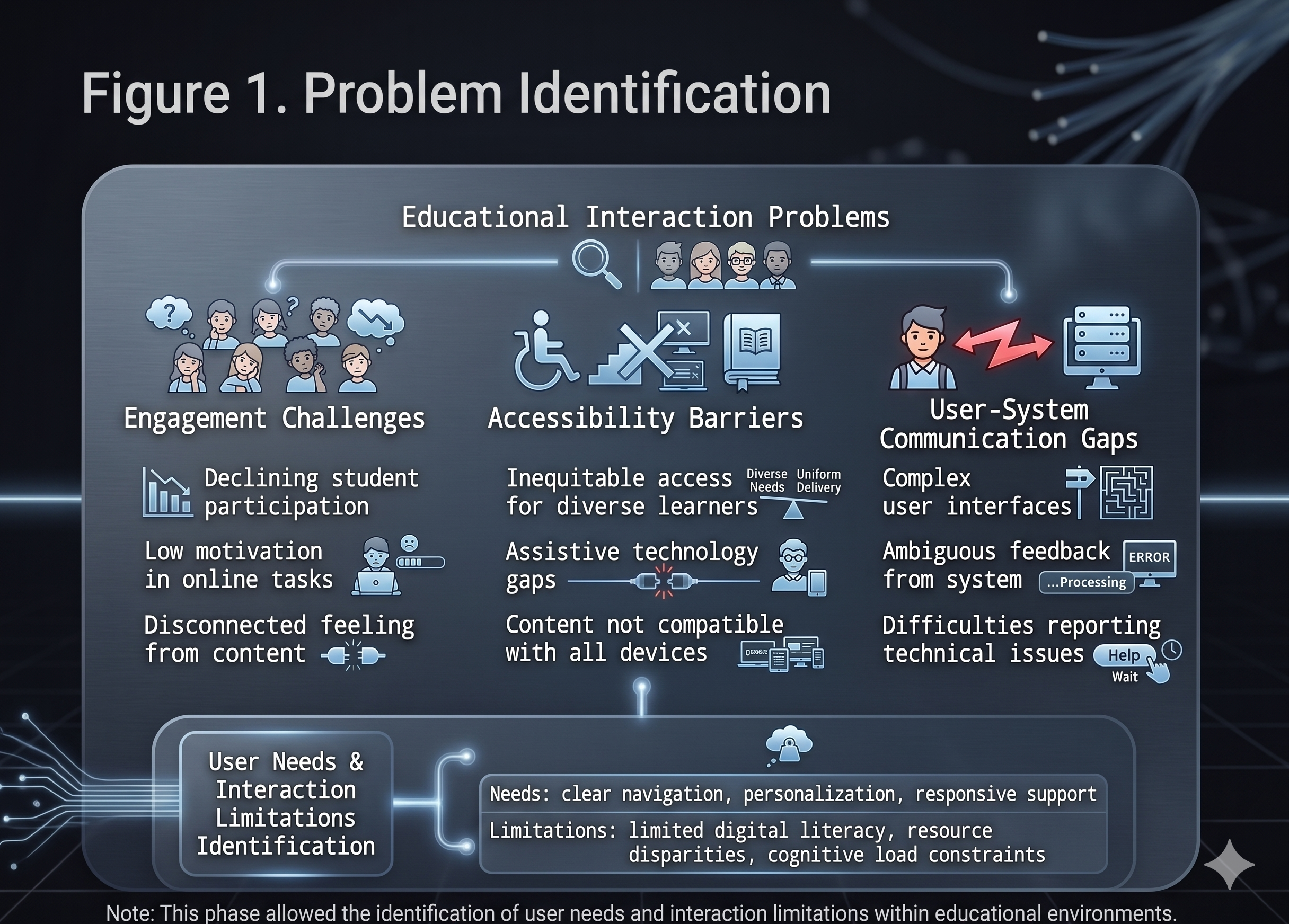
Identifying gaps in current educational technology and understanding limitations of traditional e-learning platforms.
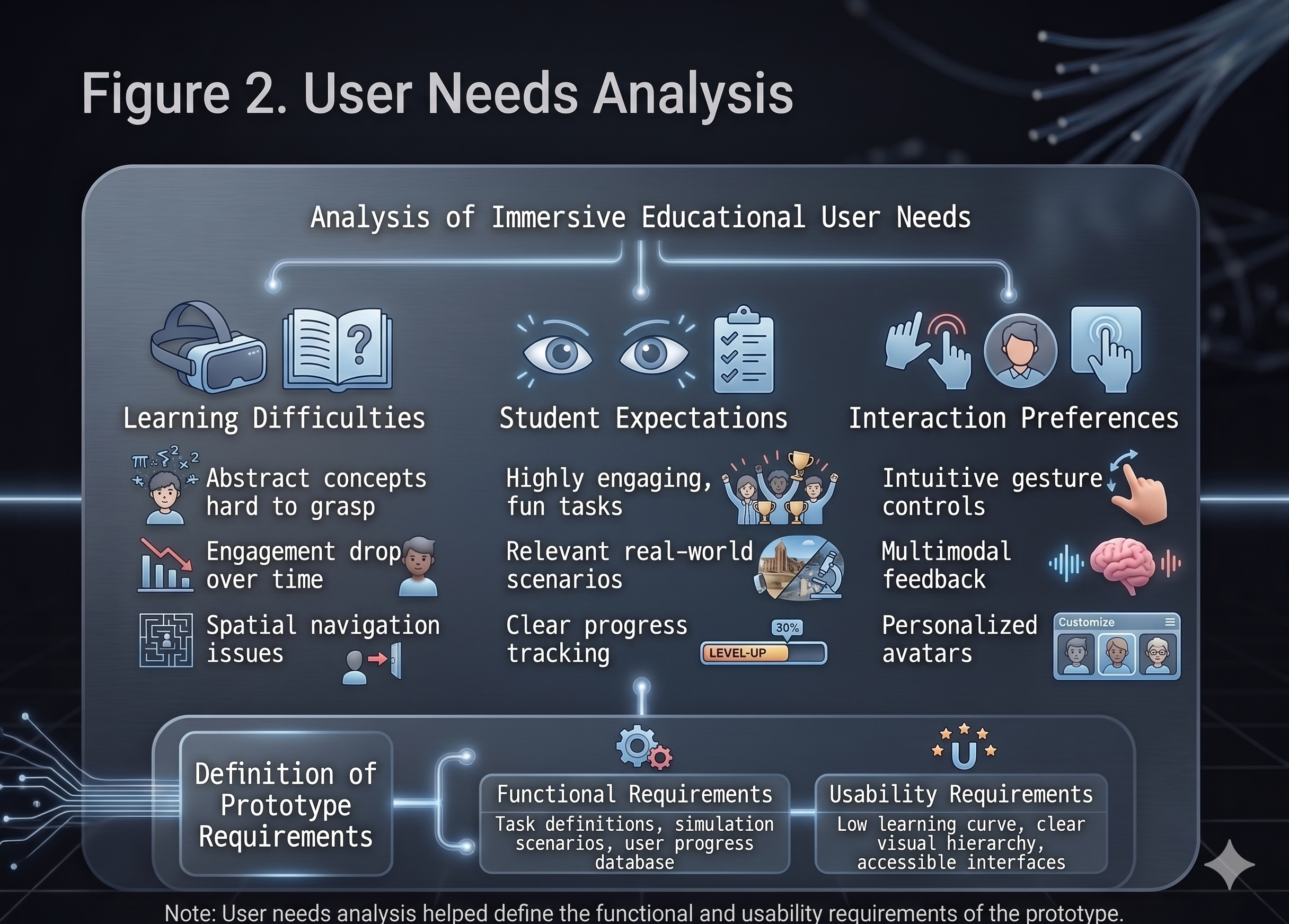
Conducting interviews, surveys, and contextual inquiry with students and educators.
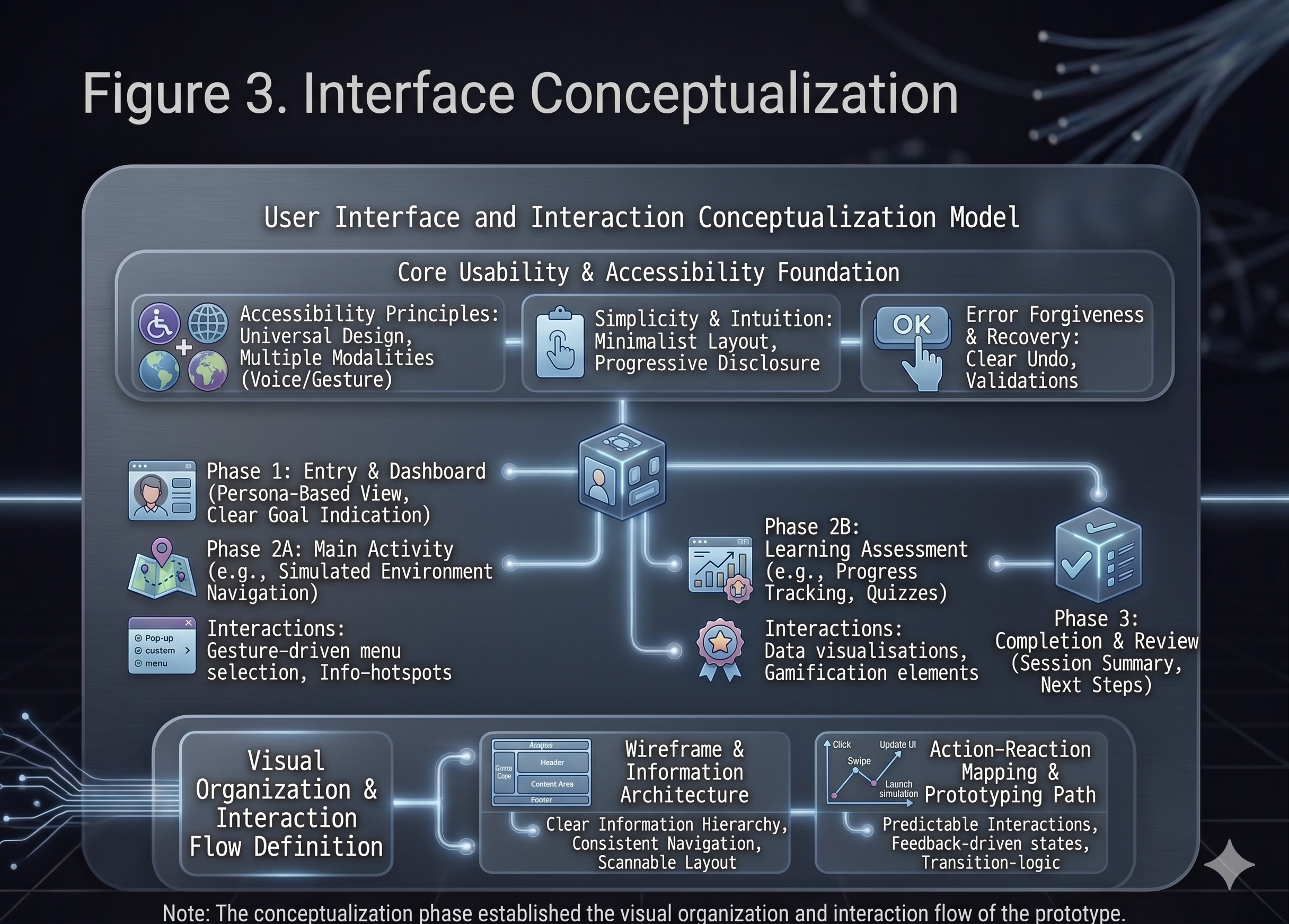
Defining interaction patterns, spatial UI layouts, and information architecture.
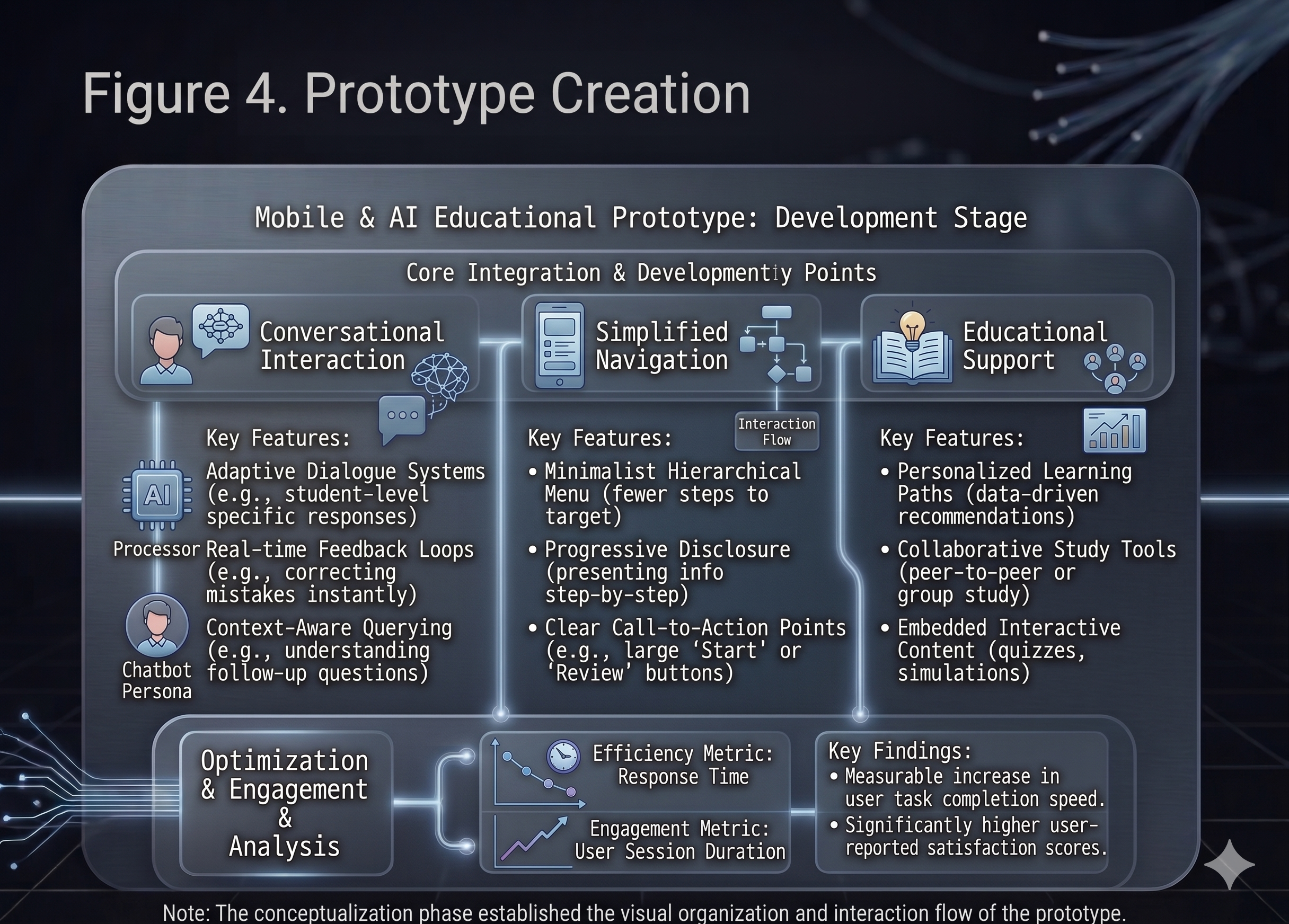
Building functional MR prototypes implementing core learning interactions.
Mapping user journeys, defining gesture vocabularies and navigation structures.
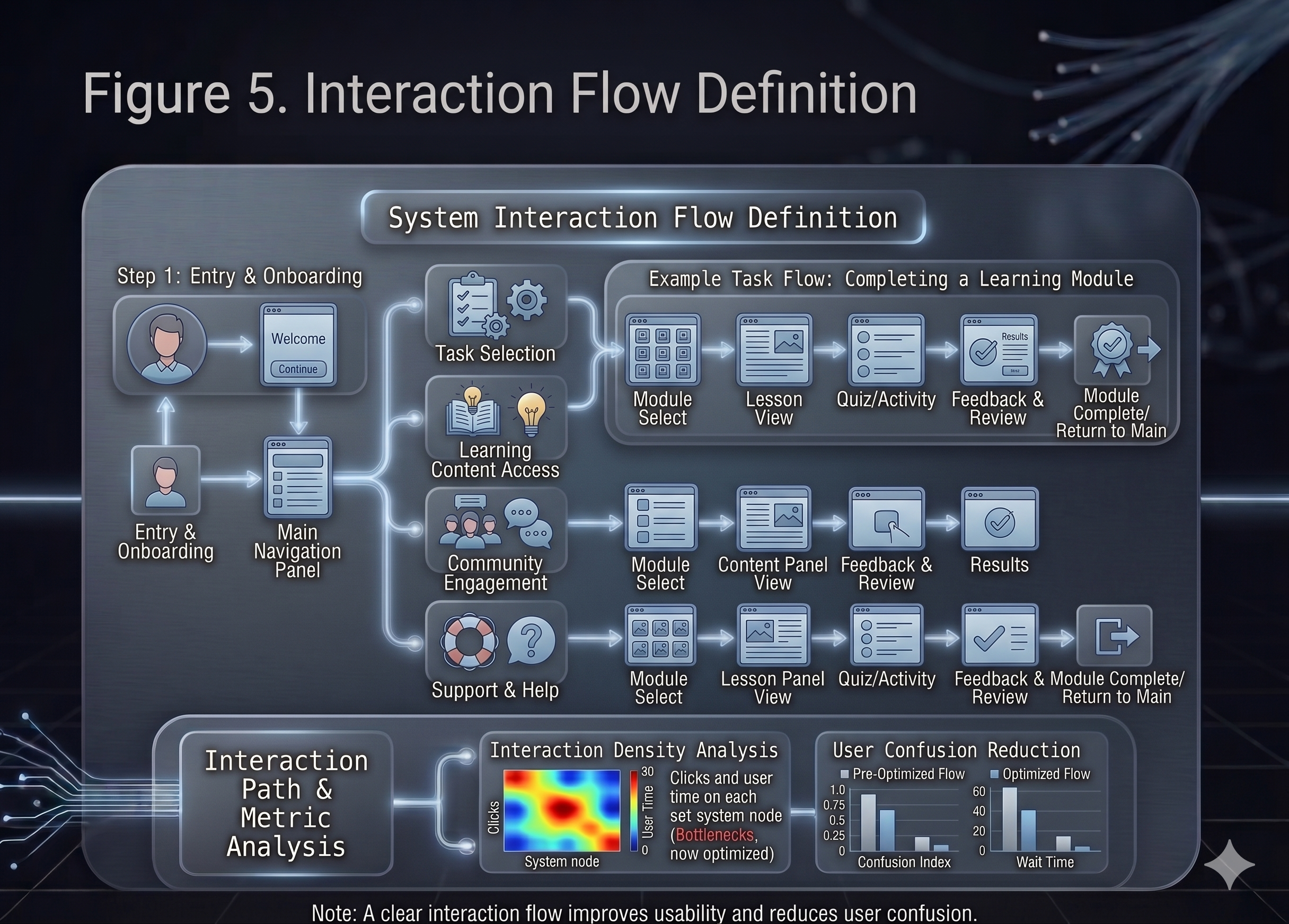
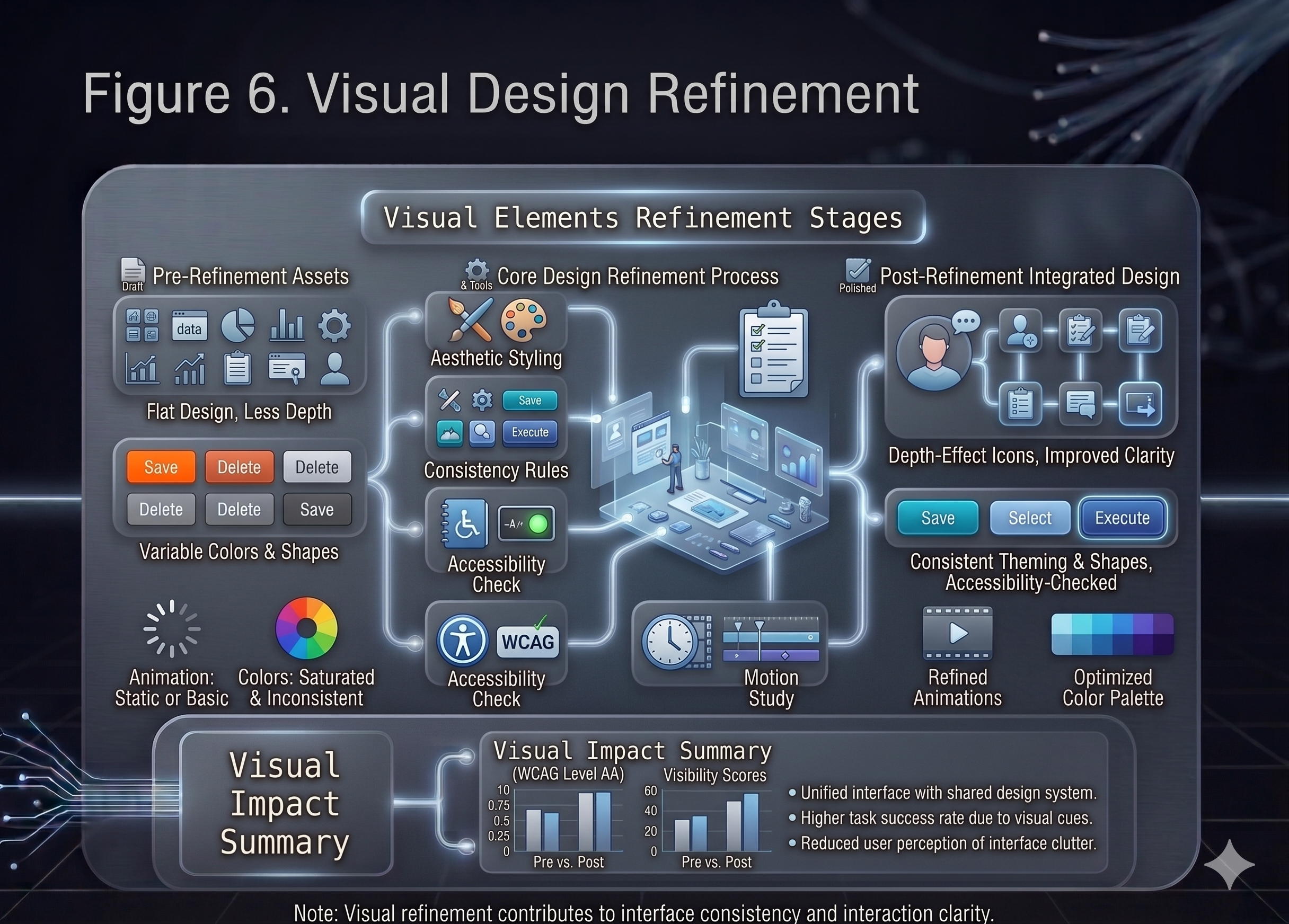
Applying visual hierarchy, color coding, and spatial typography.
Conducting usability testing with representative users, collecting metrics and feedback.
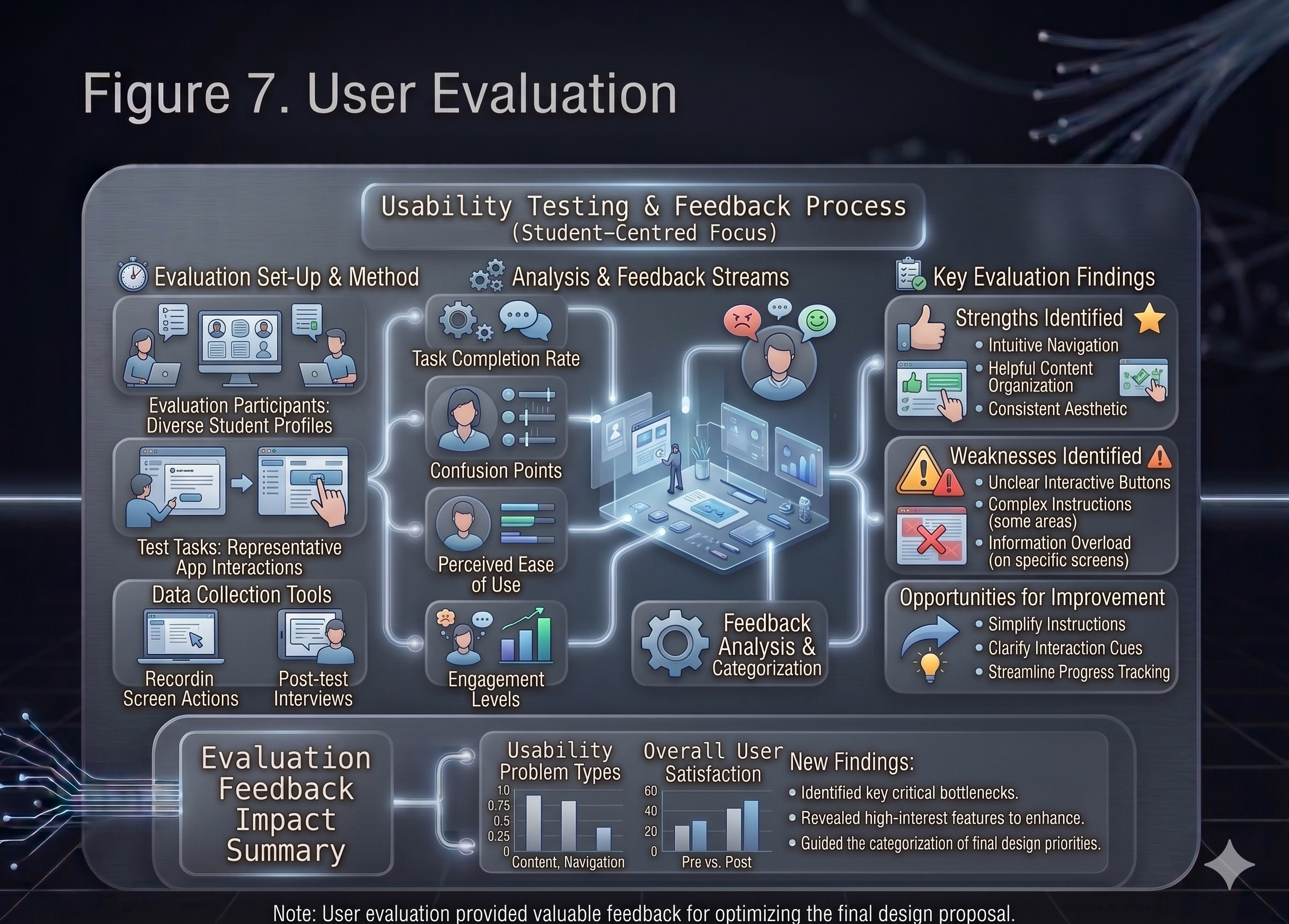
Quantitative & Qualitative Findings
| Evaluation Aspect | Score |
|---|---|
| Voice Assistant Button Visibility | 4.00 / 5 |
| Listening Animation Clarity | 4.40 / 5 |
| Instruction Message Clarity | 4.20 / 5 |
| Comfort Using the Assistant | 4.40 / 5 |
| Menu Organization | 4.20 / 5 |
| Icon Clarity | 4.40 / 5 |
| Back Button Visibility | 4.20 / 5 |
| Step-by-Step Task Breakdown | 4.00 / 5 |
| Deadline Visibility | 4.60 / 5 |
| Confirm Complete Button | 4.60 / 5 |
- • Voice interaction created natural user experience
- • Step-by-step task breakdown was highly valued
- • Menu organization was clear and intuitive
- • High engagement levels with immersive elements
- • More visible and prominent animations
- • Additional notifications for pending tasks
- • Better guidance for first-time users
- • Progress and scoring indicators
Iterative Improvements & Next Steps
Based on feedback from usability testing, several improvements are proposed to enhance user experience and address identified challenges. These adjustments prioritize user satisfaction while maintaining system simplicity and accessibility.
Visual Indicators & Animations
Enhance feedback mechanisms with more prominent animations and state changes.
Notification Systems
Add comprehensive notification systems for pending tasks and achievements.
Enhanced Onboarding
Implement clearer onboarding workflows with progressive feature disclosure.
Progress Tracking
Add visible progress bars, achievement badges, and scoring indicators.
Accessibility Enhancements
Alternative input methods, text scaling, and assistive technology support.
Interaction Clarity
Improve interaction affordances and visual hierarchy for discoverability.
Shaping the Future of Education
Mixed Reality represents an important opportunity to improve learning experiences through immersive and interactive technologies. Its integration into education can strengthen engagement, understanding, and practical learning in ways that traditional interfaces cannot match.
The prototype validation with a 4.31/5 usability score demonstrates the feasibility of well-designed MR interfaces when developed following rigorous HCI methodologies. Technology should always focus on improving human experiences while remaining inclusive and accessible for all users.
Research Impact Areas
HCI Principles Applied
User-centered design, iterative prototyping, usability testing, accessibility standards
Research Methodology
User interviews, surveys, contextual inquiry, usability testing, qualitative analysis
Technology Domain
Spatial computing, gesture recognition, voice interaction, holographic displays
Educational Impact
Learning innovation, engagement enhancement, accessibility promotion, ethical responsibility
A comprehensive UX research study exploring Mixed Reality, HCI, and educational technology.
Master's Research Portfolio © 2026 • HCI & UX Design • Jessica Garrido